

Image Details
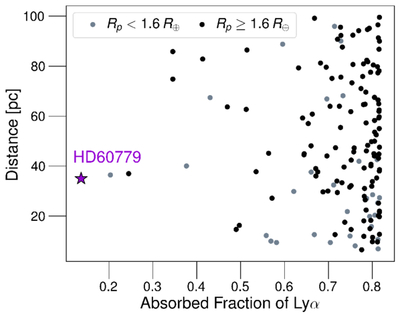
Caption: Figure 12.
Exoplanets with measured masses and radii, and with systemic RVs available in the Exoplanet Archive. The plot shows the distance to each host star versus the fraction of emitted Lyα that we expect to be absorbed by the interstellar medium (ISM). We calculated this by computing the ratio of the integrated flux from an emitted Lyα line to the integrated flux after accounting for absorption by the ISM, and subtracting this ratio from one. Note that we do not estimate the intrinsic strength of the Lyα line for any host star. We plot this metric against distance because nearer systems typically suffer less ISM absorption, as their light travels through a shorter column of interstellar material. Planet size is also indicated, since we do not expect atmospheric escape for planets smaller than 1.6 R⊕. HD 60779 b stands out as both nearby and expected to experience little Lyα ISM absorption.
Other Images in This Article
Show More
Copyright and Terms & Conditions
© 2026. The Author(s). Published by the American Astronomical Society.

