

Image Details
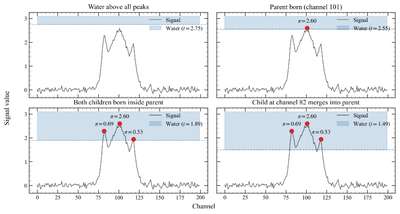
Caption: Figure 1.
Intuition for the peak-ranking step that underpins the decomposition. The descending water-level interpretation of 0D persistent homology is applied to a synthetic nested spectrum: a broad parent with two narrow children embedded on its flanks, representing the blended-line case typical of radio spectra. As the threshold t (dashed line) decreases, connected components are born at local maxima and die when they merge into an older component. Red dots mark peak births; annotations show the final persistence π = b − d. Top left: t above all peaks (empty upper-level set). Top right: the broad parent (π = 2.60) is born as the global maximum. Bottom left: both children (π = 0.69 at channel 82 and π = 0.53 at channel 118) appear as sub-islands sitting inside the parent’s territory. Bottom right: the higher-saddle child (channel 82) merges back into the parent and dies; the other child remains as a separate island.
Other Images in This Article
Copyright and Terms & Conditions
© 2026. The Author(s). Published by the American Astronomical Society.

