

Image Details
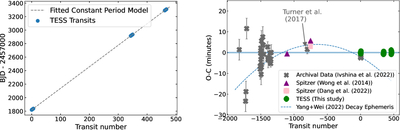
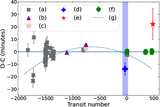
Caption: Figure 2.
Transit timing analysis results. Left: fitted midtransit times for each of the TESS transits as a function of the transit number, overlaid with the best-fit line (gray), whose slope gives the orbital period. Right: timing residuals between the observed midtransit times and those predicted by the best-fit orbital period derived from the TESS dataset. Overlaid are the Spitzer results from I. Wong et al. (2014) and L. Dang et al. (2022), as well as archival optical data reported by E. S. Ivshina & J. N. Winn (2022). The dotted line shows the difference between our best-fit ephemeris and the period-decay ephemeris from F. Yang & X. Wei (2022). The increasing difference of the TESS midtransit times from the decay ephemeris indicates that the TESS transits are inconsistent with those authors’ period-decay model. The first Spitzer data point is consistent with our ephemeris, whereas both studies of the second Spitzer transit find midtransit times offset by 3–6 minutes. However, a transit analyzed by J. D. Turner et al. (2017), observed shortly before the second Spitzer transit, was consistent with our ephemeris.
Other Images in This Article
Copyright and Terms & Conditions
© 2026. The Author(s). Published by the American Astronomical Society.

