

Image Details
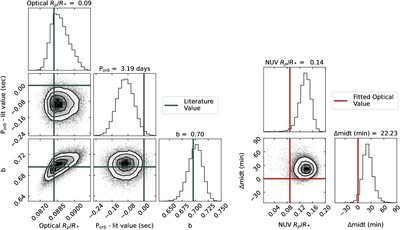
Caption: Figure 4.
Left: posterior distributions for the optical transit fit parameters, including both the ground-based ISAS data and TESS data. The optical limb-darkening coefficients were also treated as free parameters in this fit, but are not shown (see Table 2). The solid lines indicate past reported values for the impact parameter from J. A. Patel & N. Espinoza (2022), and the Rp/R⋆ and orbital period from A. Kokori et al. (2023). Right: posterior distributions for the NUV transit parameters, fit simultaneously with the optical light curves. The solid lines mark the corresponding best-fit values for the optical Rp/R⋆ and expected midtransit time from the fitted optical ephemeris, demonstrating that the NUV transit displays a larger radius and later central time.
Other Images in This Article
Copyright and Terms & Conditions
© 2026. The Author(s). Published by the American Astronomical Society.

