

Image Details
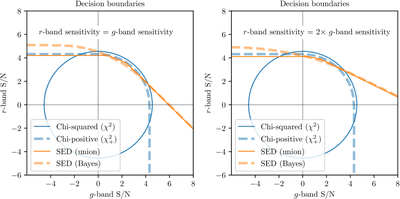
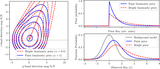
Caption: Figure 6.
Decision boundaries in signal-to-noise space for the case of two bands (g and r) and for two variants of the χ2 and SED-matched detection methods. Left: in this case, the two bands are assumed to have equal levels of noise. For the χ2 (chi-squared) detector, we show the original version and the ﹩{\chi }_{+}^{2}﹩ (chi-positive) version defined in Equation (40). For the SED-matched detector, we show a version that takes the union of detections from three SEDs and a Bayesian version that sums the detection probabilities between the same three SEDs. The SEDs are r-only, g = r + 1 mag (“red”), and g = r (“flat”). Pixels that lie above and to the right of these curves (or anywhere outside the χ2 circle) will be detected. The thresholds have been set so that each method produces the same false-positive rate given pure Gaussian noise inputs (equivalent to a 4σ Gaussian). This illustrates how the ﹩{\chi }_{+}^{2}﹩ method improves on the χ2 method by detecting more true sources, thanks to treating negative fluxes differently than positive fluxes: the blue dashed decision boundary detects more sources with positive fluxes and does not detect sources where both fluxes are negative. Notice that the SED-matched decision boundaries are shaped to have lower thresholds in directions that are consistent with the SEDs they are tuned to, as well as how the asymptotic behaviors in the r and g directions are different because we chose (for purposes of illustration) to omit a g-only filter. Right: in this case, the noise in the r filter is set to be half as large as the noise in the g filter—that is, the r image is more sensitive. The χ2 methods do not take sensitivities into account, so their decision boundaries are unchanged. The SED-matched methods, in contrast, take advantage of the fact that one unit of flux will produce more signal in the r band, and sculpt the decision boundaries accordingly.
Other Images in This Article
Show More
Copyright and Terms & Conditions
© 2026. The Author(s). Published by the American Astronomical Society.

