

Image Details
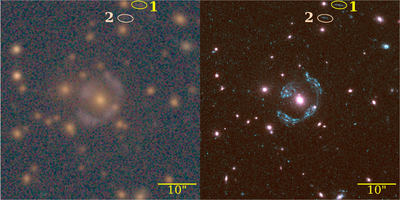
Caption: Figure 11.
Field-of-view images of AGEL0424, which is classified as a galaxy-scale deflector in a cluster-scale deflector environment. Left: DECaLS 52″ × 52″ image of the line of sight; the labels 1 and 2 enclose source candidates detected in HST data but undetected in DECaLS data. Right: deeper HST imaging in WFC3 F200LP and F140W bands reveals fainter sources (labeled 1 and 2) not readily visible in ground-based DECaLS imaging. Absent high-resolution imaging, the additional source candidates on the right figure are not visible in large-scale surveys. We measure the angular distance from the arcs to the central deflector as 22﹩\mathop{.}\limits^{\unicode{x02033}}﹩5 and 26﹩\mathop{.}\limits^{\unicode{x02033}}﹩7, respectively. Absent observations of sources with significant image separations, many cluster deflecting halos may have lensing configurations that cannot trace halo mass without consideration of the mass environment of the deflector plane.
Other Images in This Article
Show More
Copyright and Terms & Conditions
© 2026. The Author(s). Published by the American Astronomical Society.

