

Image Details
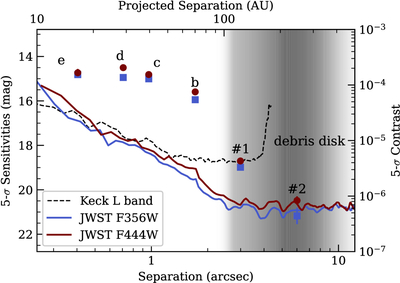
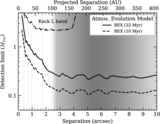
Caption: Figure 9.
Our detection limits are shown for each filter (F356W and F444W) as a function of separation from the parent star, in terms of contrast ratio (right-side axis) and apparent magnitude (left-side axis). The known planets (points with contrast ratios ∼10−4) are well above the sensitivity limits and are detected in both filters with high S/N. The pre-JWST contrast limit at L band from Keck (W. Thompson et al. 2023) is shown as a dashed line for comparison; the JWST detection limits are significantly better outside of ∼1″. Two sources (#1 and #2) are detected outside of the known planets, both of which are determined to be background objects based on earlier ALMA imagery. The shaded region filling the right side of the plot shows the location of the outer debris disk.
Other Images in This Article
Copyright and Terms & Conditions
© 2026. The Author(s). Published by the American Astronomical Society.

