

Image Details
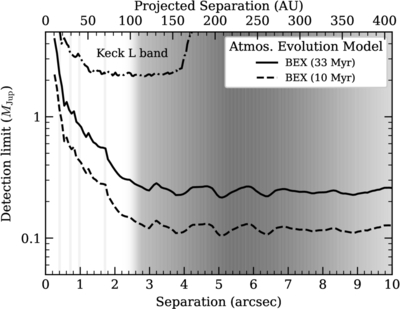
Caption: Figure 10.
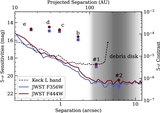
Flux sensitivities (the previous figure) are translated here to 5σ detection limits in terms of planet mass. The limits are derived from the F444W contrast curves, which correspond to lower masses than the F356W limits. For a nominal system age of 33 Myr, planets down to ∼0.3 MJup are detectable in the outer disk. If the system age is at the lower end of estimates from dynamical modeling (10 Myr; A. G. Sepulveda & B. P. Bowler 2022), limits approach 0.1 MJup (dashed line). The Keck L band contrast limits from the previous figure are also translated to mass limits (dotted–dashed line), for an age of 33 Myr. Grey shading indicates the location of the known planets and (to the right) the outer debris disk, as in the previous figure.
Other Images in This Article
Copyright and Terms & Conditions
© 2026. The Author(s). Published by the American Astronomical Society.

