

Image Details
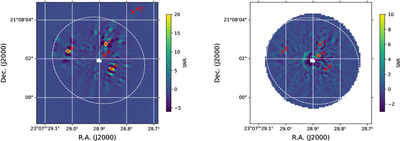
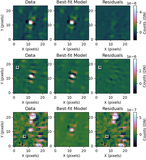
Caption: Figure 3.
JWST/NIRCam F444W image with color stretch optimized to emphasize the planets. While planets b, c, and d stand out in the initial postprocessed image (left), planet e is not readily apparent. This is partly due to its relative faintness (86% of its light is blocked by the coronagraph mask), but also because of contamination from the complex PSFs of the other planets (see Figures 4 and 5 for examples of PSFs). Once the PSFs of b, c, and d are subtracted from the image (right), planet e becomes prominent. The white dashed ellipse in each frame corresponds to an orbital radius of 100 au, inclined to match the disk orientation.
Other Images in This Article
Copyright and Terms & Conditions
© 2026. The Author(s). Published by the American Astronomical Society.

