

Image Details
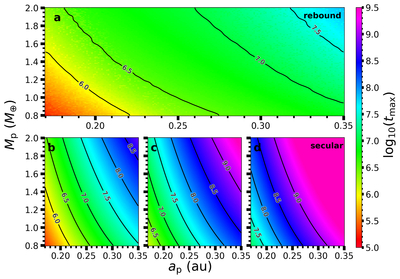
Caption: Figure 2.
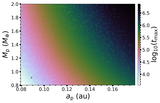
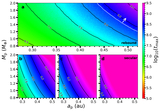
Stability simulation results for a HZ planet–moon orbiting an M2 dwarf. Logarithm of maximum moon lifetime (﹩{\mathrm{log}}_{10}\left[{t}_{{\rm{\max }}}\right]﹩) from simulations considering a range of host planet masses (0.8–2 M⊕) and semimajor axis within the HZ of an M2 dwarf. (a) shows results from N-body simulations using rebound with a tidal time-lag τp of 698 s, while (b–d) show outcomes from secular tidal theory (R. Barnes 2017) with tidal dissipation timescales τp of (b) 698 s, (c) 100 s, and (d) 10 s. Contour lines indicate ﹩{\mathrm{log}}_{10}({t}_{{\rm{\max }}})﹩ values, reflecting the time of moon loss due to tidal migration. Red, yellow, green, and blue regions represent increasingly longer lifetimes while purple regions represent the longest lifetimes.
Other Images in This Article
Copyright and Terms & Conditions
© 2025. The Author(s). Published by the American Astronomical Society.

