

Image Details
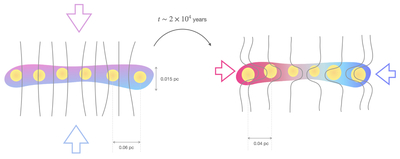
Caption: Figure 9.
The schematic view of G35. The large-elongated structure and yellow circles indicate the filament and dense cores in G35. The gray lines show magnetic field lines. Magnetic field lines are initially perpendicular to the major axis of the filament (Left). As the density increases, the gas moves and drags the magnetic field lines (Right). Cores are also moved along the filament, making a short separation. The black arrow represents the time evolution of the filament. Colored arrows show gas movement based on velocity gradients.
Other Images in This Article

Copyright and Terms & Conditions
© 2025. The Author(s). Published by the American Astronomical Society.

Copyright ©
2025 Astronomy Image Explorer. All Rights Reserved.
