

Image Details
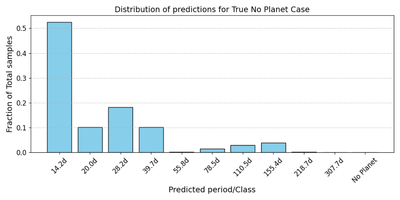
Caption: Figure 29.
Distribution of predicted period classes for systems without planetary companions (the “no planet” scenario). Period classes are shown in days. The distribution is heavily skewed toward the shortest period bin, with more than 50% of the NP samples assigned to the lowest class despite the absence of a periodic signal. A smaller grouping is also visible near the solar rotation period (around 25–30 days), though it is far less prominent than the dominant low-period peak. This highlights the model’s tendency to predict short-period signals in the absence of true planetary signal, likely influenced by residual stellar variability or low-level noise mimicking short-timescale periodicity. This prediction pattern differs significantly from the typical orbital period distributions, reflecting the distinct nature of nonplanetary light curves, characterized by residual stellar variability or noise rather than periodic transit-like features.
Other Images in This Article
Show More
Copyright and Terms & Conditions
© 2025. The Author(s). Published by the American Astronomical Society.

