

Image Details
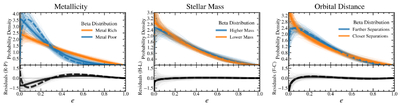
Caption: Figure 7.
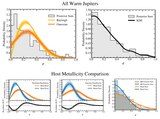
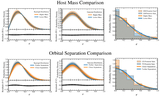
Results from our HBM test assuming a Beta distribution for the underlying eccentricity distribution with an emphasis on host star metallicity, mass, and orbital separation. Left: the orange and blue lines display the median inferred underlying eccentricity distribution of warm Jupiters when considering only the impact of stellar metallicity. Solid lines represent a truncated Gaussian hyperprior, while the dashed lines represent a log-uniform hyperprior. The lower panel displays the residuals of planets orbiting metal-rich host stars ([Fe/H] ≥ 0) subtracted from planets residing in metal-poor systems ([Fe/H] < 0). Thin gray lines in the background show randomly sampled distributions from the α and β hyperparameter posteriors. Middle: HBM test analyzing host star mass. The lower panel shows the residuals of the distribution of planets around higher-mass host stars with M⋆ ≥ 1.15 M⊙ subtracted from lower-mass host stars with M⋆< 1.15 M⊙. Right: HBM test with a focus on orbital separation. The lower panel shows the residuals of the distribution of planets at farther separations (100 days ≤ P < 365 days) subtracted from those at close separations from their host stars (10 days < P < 100 days).
Other Images in This Article
Copyright and Terms & Conditions
© 2025. The Author(s). Published by the American Astronomical Society.

