

Image Details
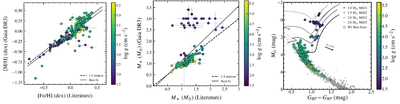
Caption: Figure 2.
Left: stellar host metallicity measurements compiled from the literature and used in this analysis compared with metallicities derived from Gaia DR3 RVS spectra (Gaia Collaboration 2022). Individual warm Jupiter host stars are colored by Gaia log g to highlight main-sequence stars (log g > 4.0 dex) and post-main-sequence stars (log g < 4.0 dex). The dashed line represents the 1:1 relation, while the solid line shows the best-fit linear relation. Middle: stellar masses used in this analysis compared with uniformly inferred FLAME masses from Gaia. Systems that lie well above the 1:1 line have Gaia surface gravities suggesting they are massive post-main-sequence stars. Right: host stars plotted on a Gaia MG vs. GBP − GRP color–magnitude diagram. Iso-mass tracks spanning 1.0–3.0 M⊙ are shown with solar metallicities ([Fe/H] = 0 dex). The most evolved stars tend to have the highest stellar masses.
Other Images in This Article
Copyright and Terms & Conditions
© 2025. The Author(s). Published by the American Astronomical Society.

