

Image Details
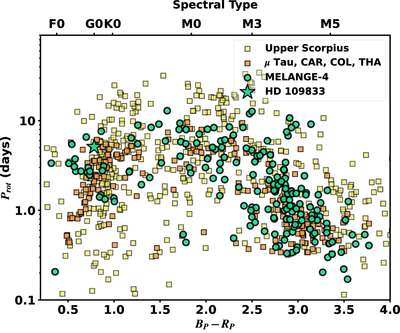
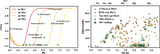
Caption: Figure 4.
Rotation periods of candidate members of MELANGE-4 as a function of Gaia B P − R P color. We compare the color–period sequence of candidate members to the younger (∼10 Myr) population of Upper Scorpius (Rebull et al. 2018) and older (45–60 Myr) populations of Carina (CAR), Columba (COL), Tucana-Horologium (THA), and μ Tau (Gagné et al. 2020). As expected, the MELANGE-4 sequence shows more coherence than the sequence of the younger Upper Scorpius. The low-mass candidates rotate slower than those in the 45–60 Myr populations, indicating a younger population that will spin up as they contract onto the main sequence. The high-mass candidates are a mix of still rapidly rotating stars and stars that have begun to spin down.
Other Images in This Article

Show More
Copyright and Terms & Conditions
© 2023. The Author(s). Published by the American Astronomical Society.

