

Image Details
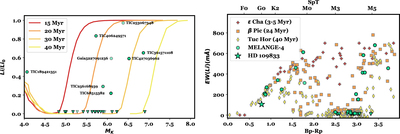
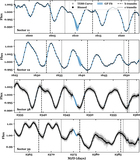
Caption: Figure 7.
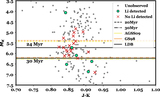
Lithium measurements for MELANGE-4. (Left) Fraction of initial Li abundance as a function of absolute K magnitude, overplotted with DSEP magnetic isochrones (Feiden 2016). EWs of association members were converted to Li/Li0 using the curve of growth from Zapatero Osorio et al. (2002). The transparency of the points corresponds to their kinetic membership probability from BANYAN Σ, such that the most likely interlopers are the faintest. (Right) Comparison of MELANGE-4 Li sequence and Li sequences of known associations. For members of each association, Li EWs are shown as a function of Gaia Bp − Rp. EWs of MELANGE-4 members marked with downward triangles are upper limits. The transparency of the points corresponds to their kinetic membership probability from BANYAN Σ, such that the most likely interlopers are the faintest. Li measurements of MELANGE-4 members are supplemented with an additional five measurements from Mamajek et al. (2002), Torres et al. (2006), and Pecaut & Mamajek (2016). The Li measurements of β Pic members are taken from Shkolnik et al. (2017), measurements of ϵ Chamaeleontis members from Murphy et al. (2013), and measurements for Tuc-Hor from da Silva et al. (2009) and Kraus et al. (2014).
Other Images in This Article

Show More
Copyright and Terms & Conditions
© 2023. The Author(s). Published by the American Astronomical Society.

