

Image Details
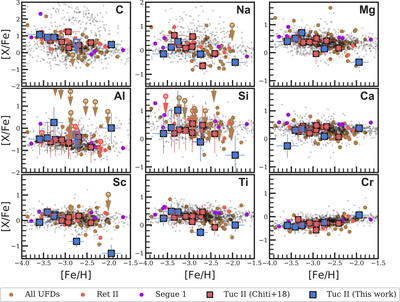
Caption: Figure 3.
[X/Fe] vs. [Fe/H] trends for stars in our Tucana II sample (large blue squares), stars in the inner region of Tucana II (red squares), and other UFDs (brown circles) for carbon, odd-Z elements (Na, Al, Sc), α-elements (Mg, Si, Ca, Ti), and Cr. The Ret II and Segue 1 UFDs are shown as red circles and orange circles, respectively, due to their interesting chemical signatures (e.g., exceptional r-process enhancement in Ret II, and a flat α-element abundance trend in Segue 1). The gray data points correspond to abundances for MW halo stars from the compilation of Abohalima & Frebel (2018). The abundances largely follow the overall UFD trends, with the exception of a low Ca abundance for the most metal-poor star in the system and a low Mg and Sc abundance in the most metal-rich star in the system. UFD chemical abundance data are from Koch et al. (2008), Feltzing et al. (2009), Norris et al. (2010a), Norris et al. (2010b), Simon et al. (2010), Frebel et al. (2010), Lai et al. (2011), Gilmore et al. (2013), Koch et al. (2013), Frebel et al. (2014), Ishigaki et al. (2014a), Roederer & Kirby (2014), François et al. (2016), Ji et al. (2016c), Frebel et al. (2016), Ji et al. (2016c), Roederer et al. (2016), Hansen et al. (2017), Kirby et al. (2017), Chiti et al. (2018a), Nagasawa et al. (2018), Spite et al. (2018), Ji et al. (2019), Marshall et al. (2019), Hansen et al. (2020), and Ji et al. (2020b).
Other Images in This Article
Copyright and Terms & Conditions
© 2023. The Author(s). Published by the American Astronomical Society.

