

Image Details
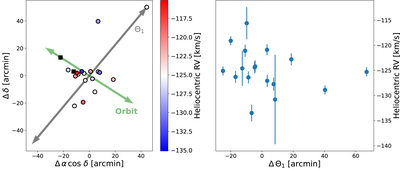
Caption: Figure 7.
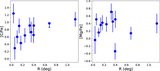
Left: spatial location of members of Tucana II with respect to the center of Tucana II. Stars are colored by their heliocentric radial velocity measurements, as presented in Walker et al. (2016), Chiti et al. (2021), and this study; stars that show evidence of binarity (TucII-078 and TucII-309; see Section 3.1) are displayed as black squares. The arrow corresponds to the axis defined by the angle (θ 1) along which the most distant member lies. The green arrow denotes the direction of Tucana II orbit from Chiti et al. (2021). Right: heliocentric radial velocities of Tucana II members as a function of projected distance along the axis on which the most distant member lies. We find no evidence of a radial velocity gradient along this axis, deriving a slope of ﹩{{dv}}_{\mathrm{helio}}/d{\theta }_{1}\,=\,-{2.5}_{-2.9}^{+2.9}﹩ km s−1 deg−1.
Other Images in This Article
Copyright and Terms & Conditions
© 2023. The Author(s). Published by the American Astronomical Society.

