

Image Details
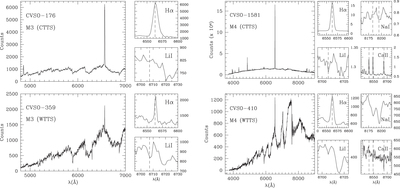
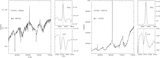
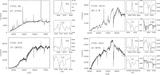
Caption: Figure 8.
Left: spectra of two M3-type TTSs obtained with the Hydra spectrograph on the WIYN 3.5 m telescope. In the upper panel, the CTTS CVSO-176 has a W(Hα) ﹩=\,-41.4﹩ Å and W(Li I) ﹩=\,0.2﹩ Å. The Hβ Balmer line is also in emission, as are the He I lines at 5876 Å and 6876 Å. In the lower panels, the WTTS star CVSO-359 has a W(Hα) ﹩=\,-2.5﹩ Å and W(Li I) ﹩=\,0.6﹩ Å. Other than Hα, no other lines are seen in emission. In both stars, the S/N in the region between Hα and Li I is ∼35. Right: spectra of two candidates confirmed as new M4 TTS members of Orion, obtained with the Hectospec spectrograph on the 6.5 m MMT. In the upper panel, we plot an extreme CTTS, with W(Hα) ﹩=\,-83.6﹩ Å and W(Li I) ﹩=\,0.1﹩ Å. The entire Balmer series is clearly in emission, along with the Ca H and K lines (3933 Å, 3968 Å), He I at 5876 Å and 6876 Å, [O I] 6300 Å, and [S II] 6716 Å, 6732 Å. In this star, the Na I 5890, 5895 Å doublet and the Ca II triplet (8498 Å, 8542 Å, 8662 Å) are also strongly in emission (W(Ca II8498) = −10.2 Å, W(Ca II8542) = −11.8 Å, and W(Ca II8662) = −10.5 Å). The near-IR Na I doublet has W(8183) = 0.5 Å and W(8195) = 1.1 Å. Lower panel: the M4 WTTS shown here has W(Hα) ﹩=\,-6.1﹩ Å and W(Li I) ﹩=\,0.4﹩ Å. Hβ and the Ca H and K lines are also in emission. The near-IR Na I doublet has W(8183) = 0.7 Å and W(8195) = 1.0 Å, typical of M-type stars with lower than main-sequence gravities (Luhman et al. 2003; Schlieder et al. 2012).
Other Images in This Article
Show More
Copyright and Terms & Conditions
© 2019. The American Astronomical Society. All rights reserved.

