

Image Details
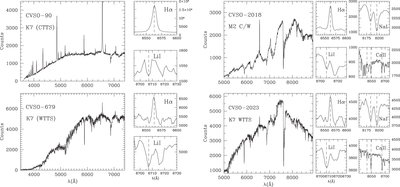
Caption: Figure 10.
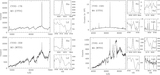
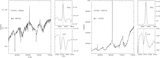
Left: spectra of K7-type TTS obtained with the FAST spectrograph on the SAO 1.5 m telescope. In the upper panels, the CTTS CVSO-90 shows the characteristic extreme emission-line spectrum of a strongly accreting TTS; the equivalent width of the Hα emission line is W(Hα) ﹩=\,-97﹩ Å. The equivalent width of Li I is W(Li I) ﹩=\,0.2﹩ Å, and the absorption line next to it is the Ca I line at 6716 Å. The entire Balmer series is seen clearly in emission; also in emission are the Ca H and K lines (3933 Å, 3968 Å), [O I] at 6300 Å, and He I at 5876 Å and 6876 Å. In contrast, the WTTS CVSO-679 in the lower panels has a weak W(Hα) ﹩=\,-1.6﹩ Å, and no other emission lines; in this star, W(Li I) ﹩=\,0.4﹩ Å. Right: spectra of two newly identified TTSs obtained with the GHTS spectrograph on the SOAR 4.1 m telescope. In the upper panels, the C/W type (see Section 3.3) CVSO-2018 shows the characteristic strong emission-line spectrum of a moderately accreting TTS; the equivalent width of the Hα emission line is W(Hα) ﹩=\,-9.9﹩ Å. The equivalent width of Li I is W(Li I) ﹩=\,0.2﹩ Å, and the absorption line next to it is the Ca I line at 6716 Å. The K7 WTTS CVSO-2023 in the lower panels has a weak W(Hα) ﹩=\,-1.4﹩ Å; in this star, W(Li I) ﹩=\,0.5﹩ Å. In all spectra, the S/N in the region between Hα and Li I is ﹩\gtrsim 20﹩.
Other Images in This Article
Show More
Copyright and Terms & Conditions
© 2019. The American Astronomical Society. All rights reserved.

