

Image Details
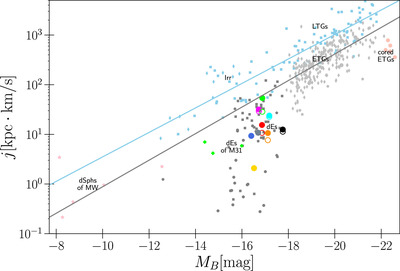
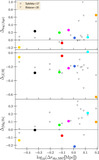
Caption: Figure 7.
Estimate of the stellar specific angular momentum j vs. absolute magnitude (B band) for various galaxy types. For those studies where the magnitude was not stated, we consulted Hyperleda (D. Makarov et al. 2014). For ETG samples, we estimated j from the stated velocity curves (see the text), and when velocity data were noisy, we clipped outliers. For the LTG samples, we used the j directly from the source tables. Blue diagonal: fit to all LTG points (﹩{\mathrm{log}}_{10}j=-0.2465\cdot {M}_{B}+\mathrm{const}.﹩). Gray diagonal: fit to “ordinary” ETGs with M B ∈ [18.5, 21] mag (﹩{\mathrm{log}}_{10}j=-0.2673\cdot {M}_{B}+\mathrm{const}.﹩). Massive ETG and LTGs (M * ≳ 1010 M ☉) are known to roughly follow the same relation (﹩j\propto {M}_{* }^{2/3}﹩), but LTGs are offset toward higher j (see S. M. Fall 1983; R. Bender & J. L. Nieto 1990; A. J. Romanowsky & S. M. Fall 2012). Large, colored points: our Virgo dE sample (inclination-corrected: filled, not-corrected: open). Small green crosses: the dE satellites of M31 (NGC 147, NGC 185, NGC 205) inferred from individual stars (M. Geha et al. 2006, 2010) with velocity curves out to ∼8r e. Studies of integrated light (smaller FOV) suggest significantly smaller velocities (R. Bender et al. 1991; F. Simien & P. Prugniel 2002). Gray squares: long-slit dE observations from E. Toloba et al. (2015). Gray dots: dEs from M. Geha et al. (2003), some of which have exceptionally low j (presumably because of a very small FOV or a slit not aligned with the kinematic major-axis). Gray and light-gray pentagons: ETG sequence (dwarfs and “ordinary” ETGs) of R. Bender & J. L. Nieto (1990). Faint, red stars: dSphs of the Milky Way from A. M. Martínez-García et al. (2021). For these, j is from intrinsic velocities as they derived their values from the Gaia proper motions and radial velocities of individual stars. Light-gray diamonds: the ETGs of E. Emsellem et al. (2011). Light-gray dots: power-law ETGs of K. Mehrgan et al. (2023). Light-red dots: giant cored ETGs of K. Mehrgan et al. (2023). Light-blue diamonds: dwarf irregulars of S. Kurapati et al. (2018; j is of stars only). Light-blue squares: dwarf and massive spirals of L. Posti et al. (2018).
Other Images in This Article
Show More
Copyright and Terms & Conditions
© 2024. The Author(s). Published by the American Astronomical Society.

