

Image Details
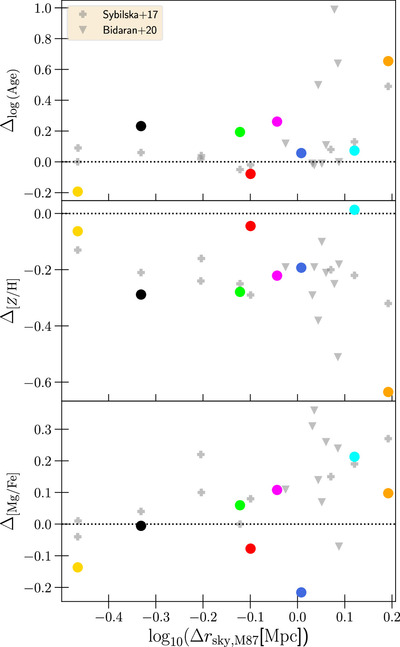
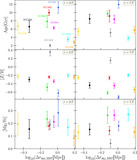
Caption: Figure 10.
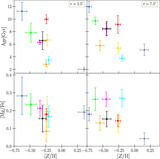
The log-linear population gradients vs. environment for our sample together with the Virgo dEs of A. Sybilska et al. (2017) and B. Bidaran et al. (2023). Both studies are based on IFU data, and gradients are defined as the fitted slope of ﹩\mathrm{log}\left(\mathrm{age}\right)﹩, Z/H, and [Mg/Fe] within one stellar effective radius ﹩\mathrm{log}({r}_{{\rm{e}}})﹩. The gradients for our dE sample are measured as the change between two apertures we have spectra for, i.e., ﹩\mathrm{log}(r=7.^{\prime\prime} 5)﹩ and ﹩\mathrm{log}(r=2.^{\prime\prime} 5)﹩. VCC 1910 is excluded because of its poor inner spectrum.
Other Images in This Article
Show More
Copyright and Terms & Conditions
© 2024. The Author(s). Published by the American Astronomical Society.

