

Image Details
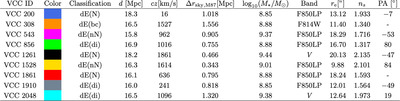
Caption: Figure 2.
Basic Properties of the Galaxy Sample From left to right: the Virgo Cluster Catalog (VCC) identification number (B. Binggeli et al. 1985); the color identification used throughout this article; the morphological subclassification following T. Lisker et al. (2007; bc: blue center, di: disk feature, N: classical dE with nucleus, nN: classical dE without nucleus); the distance adopted from J. P. Blakeslee et al. (2009)—if there are no distances available (other than from redshifts), we use the average Virgo Cluster distance of 16.5 Mpc; the heliocentric velocity cz that we measured from the spectra; the projected distance to M87 (assuming d = 16.5 Mpc); the stellar mass we obtained; the photometric band we use for modeling of the light distribution; effective radius (in the z band), Sérsic index, and position angle all adopted from L. Ferrarese et al. (2006), who investigated all galaxies in our sample except for VC 308 (for which we consulted Hyperleda instead; D. Makarov et al. 2014). Note that VCC 308 and VCC 1861 appear almost perfectly round; therefore, a robust PA is not given.
Other Images in This Article
Show More
Copyright and Terms & Conditions
© 2024. The Author(s). Published by the American Astronomical Society.

