

Image Details
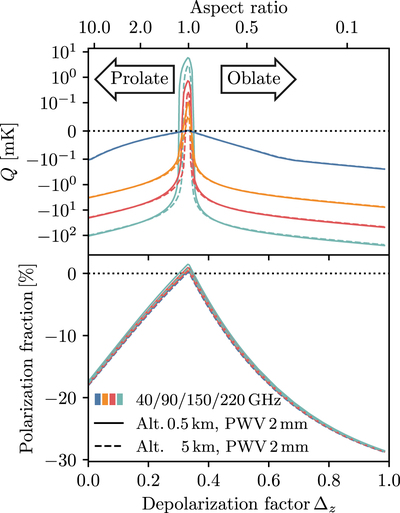
Caption: Figure 3.
Polarized signal from Rayleigh scattering of thermal emission from the ground and the atmosphere for different cloud particle shapes. Assuming homogeneous spheroidal cloud particles with uniform dielectric properties, the particle shape is parameterized by its aspect ratio, or equivalently, the depolarization factor Δ z . The linear polarization from an ensemble of randomly oriented cloud particles with the short axis aligned vertically is computed for each of the four CLASS frequency bands (color coded), for different cloud heights above the ground (5200 m above sea level), with a total 2 mm PWV. The cloud height and PWV determine the optical loading above the cloud (Equation (3)), and impact the polarization from the forward scattering of atmospheric emission, especially at higher frequencies. Top: the Stokes Q polarization signal in units of brightness temperature for a reference optical depth τ ν equivalent to IWP = 10 g m−2 and particle diameter D = 100 μm (geometric mean of the three axes). Bottom: the corresponding polarization fraction. Signed values are used to distinguish the sign of Stokes Q polarizations.
Other Images in This Article
Show More
Copyright and Terms & Conditions
© 2023. The Author(s). Published by the American Astronomical Society.

