

Image Details
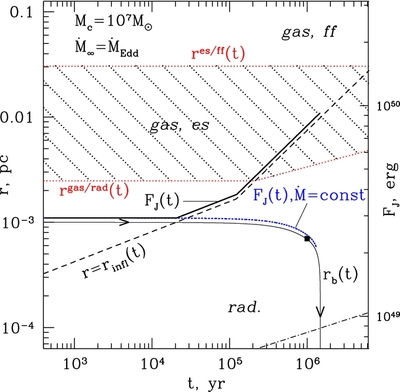
Caption: Figure 5.
Characteristic evolution of the torque
F
J
(labeled on the right axis) experienced by the central binary with
M
c
= 10
7
M
☉ and
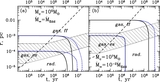
q = 1 as a function of time. Two cases are shown:
F
J
(
t) computed self-consistently accounting for the circumbinary disk evolution (thick black solid line) and assuming a standard
constant
 disk (blue dotted line). In both cases, the mass accretion rate in the disk far from the binary is the same and equal to
 M
Edd. Note the difference between the values of
F
J
computed in two ways for
t
M
Edd. Note the difference between the values of
F
J
computed in two ways for
t
 10
5 yr. Also shown is the orbital evolution of the binary (thin solid line) computed according to the first, self-consistent
prescription for
F
J
(
t). Different regimes in which the disk can be present are labeled on the plot (red dotted lines
r
rad/gas and
r
es/ff show their boundaries) and the gas pressure dominated case with κ = κ
es is shaded. The dashed curve shows the run of
r
infl(
t) in different regimes, and is closely related to the behavior of the self-consistent
F
J
(
t). The Eddington limit becomes important below the dot-dashed line in the lower right corner of the plot; see Section 6.2.6.
The black square dot marks the transition from the disk- to GW-dominated orbital evolution of the binary. See the text for
more details.
10
5 yr. Also shown is the orbital evolution of the binary (thin solid line) computed according to the first, self-consistent
prescription for
F
J
(
t). Different regimes in which the disk can be present are labeled on the plot (red dotted lines
r
rad/gas and
r
es/ff show their boundaries) and the gas pressure dominated case with κ = κ
es is shaded. The dashed curve shows the run of
r
infl(
t) in different regimes, and is closely related to the behavior of the self-consistent
F
J
(
t). The Eddington limit becomes important below the dot-dashed line in the lower right corner of the plot; see Section 6.2.6.
The black square dot marks the transition from the disk- to GW-dominated orbital evolution of the binary. See the text for
more details.
Other Images in This Article
Copyright and Terms & Conditions
© 2013. The American Astronomical Society. All rights reserved.

