

Image Details
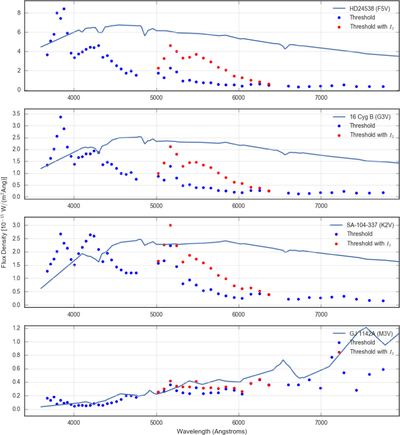
Caption: Figure 15.
Flux density vs. wavelength for F5, G3, K2 main-sequence, and M2 dwarf stars (blue) with typical corresponding magnitudes, Vmag = 7, 8, 8, and 10, and the associated flux density detection thresholds for laser emission superimposed on such a spectrum. Detection thresholds for spectra without iodine contamination (blue points) and with iodine (red) vary significantly by wavelength and among spectral types. F star thresholds vary between 10−14 W m−2 Å−1 in the near-UV (at left) to less than 1 × 10⁻¹⁵ W m−2 Å−1 at 7800 Å. The G thresholds vary over the same wavelength range from 3.4 × 10⁻¹⁵ to 0.2 × 10⁻¹⁵ W m−2 Å−1. The K stars exhibit slightly higher thresholds in the blue, and range from 2.6 × 10⁻¹⁵ to 0.2 × 10⁻¹⁵ W m−2 Å−1. Finally, the M stars show detection thresholds significantly lower due to the inherent low luminosity of such stars, ranging from 0.1 × 10⁻¹⁵ to 0.8 × 10⁻¹⁵ W m−2 Å−1. The variation in the detection threshold for laser emission was computed by trials of injection and recovery of synthetic laser emission lines inserted directly into our spectra and analyzed blindly to determine if they would have been detected.
Other Images in This Article
Show More
Copyright and Terms & Conditions
© 2017. The American Astronomical Society. All rights reserved.

