

Image Details
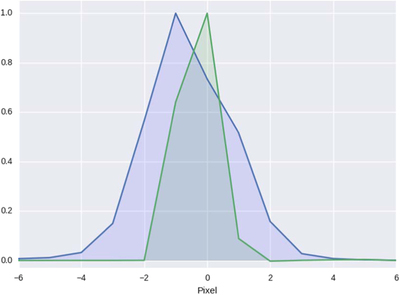
Caption: Figure 8.
Comparison of the profiles in the spatial direction of the stellar spectrum (blue line) and the laser candidate feature found in Tabby’s star (green line). The profile of the stellar spectrum reveals the instantaneous refraction by the Earth’s atmosphere (“seeing”) of a point source (the star). The laser candidate feature exhibits a profile that is demonstrably narrower than that of the star, strongly suggesting that the candidate feature does not originate from light entering the Earth’s atmosphere. The stellar spectrum profile was obtained from summing 10 consecutive columns to the left of the peak of the feature, whereas the feature profile was generated by subtracting the median of each row (i.e., subtracting the star) and summing 10 columns centered on the feature. The peak pixels of both profiles are normalized to unity. The NaN pixel in the candidate feature was assigned a value of 0 in the sum, thus the pixel in the green profile at position “0” likely has more counts than is plotted here. If more photons were associated with that saturated pixel, the laser candidate feature would simply be even narrower than that due to atmospheric seeing, thus supporting the conclusion that it did not originate from light that passed through the Earth’s atmosphere.
Other Images in This Article
Show More
Copyright and Terms & Conditions
© 2017. The American Astronomical Society. All rights reserved.

