
Image Details
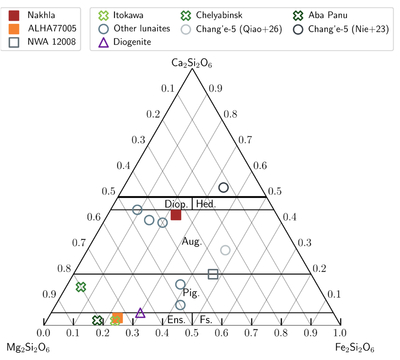
Caption: Figure 3.
Ternary diagram showing the composition of pyroxenes in Nakhla and in ALHA77005 shergottite (filled squares). The ends of the diagrams correspond to enstatite (Mg2Si2O6; Ens.), ferrosilite (Fe2Si2O6; Fs.), and wollastonite (Ca2Si2O6). The ternary diagram is sectioned to show the compositional combinations giving rise to pigeonite (low-Ca; Pig.), augite (high-Ca; Aug.), diopside (high-Ca, high-Mg; Diop.), and hedenbergite (high-Ca, high-Fe; Hed.), according to the division from W. A. F. Deer et al. (2013). The open square shows the mean composition of the NWA 12008 lunar basalt (P. Grèbol-Tomàs et al. 2025) pyroxenes, measured with the same instrument as Nakhla and ALHA77005 compositions. Open circles in grayscale show literature data for lunar samples: lunaites (E. Peña-Asensio et al. 2024) and Chang’e-5 returned samples (J. Nie et al. 2023; S. Qiao et al. 2026). Green open crosses represent ordinary chondrites (Chelyabinsk, C. E. Moyano-Cambero et al. 2017; Aba Panu, T.-J. Huang et al. 2023) and asteroidal samples from (25143) Itokawa (S. Tanbakouei et al. 2019). The purple triangle shows the reported composition of the pyroxene in the NWA 6013 diogenite (E. Peña-Asensio et al. 2024).
Other Images in This Article
Copyright and Terms & Conditions
© 2026. The Author(s). Published by the American Astronomical Society.

