

Image Details
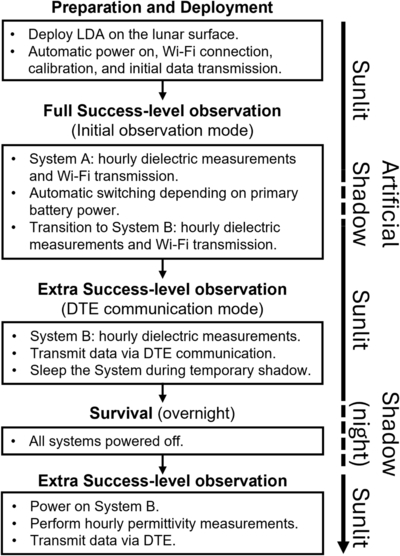
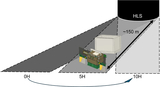
Caption: Figure 3.
Operational flow of the LDA showing the sequence of autonomous operations under changing illumination conditions. After crew-assisted deployment and activation, the LDA operates autonomously using System A during the initial sunlit phase while the HLS remains on the surface. Following depletion of the primary battery, the system transitions autonomously to System B for extended operations. During sunlit periods, System B conducts autonomous dielectric measurements powered by the SAP. When solar illumination becomes unavailable, the system automatically powers off, and upon re-illumination, it autonomously powers on and resumes measurements and communication, enabling long-term, crew-independent operation across multiple illumination cycles. “Artificial shadow” denotes shadow cast by the HLS or the protective assembly during the illuminated lunar day, under which System A performs dielectric measurements. Under nominal deployment conditions, this shadow is expected to last for at least approximately 5 hr, although its actual duration depends on the deployment geometry and local solar illumination conditions. “Shadow (night)” denotes the true lunar night, during which System B does not acquire data due to the absence of solar power.
Other Images in This Article
Copyright and Terms & Conditions
© 2026. The Author(s). Published by the American Astronomical Society.

