

Image Details
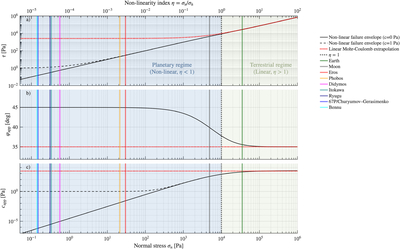
Caption: Figure 2.
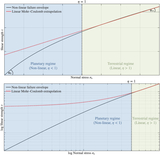
Nonlinear failure envelope for regolith in low confining stress. (a) The shear strength (τ), (b) the apparent friction angle (φapp), and (c) the apparent cohesion (capp) as a function of the normal stress (σn) and the nonlinearity index (η). Parameters representative of loose sand or gravel are used (φ∞ = 35°, Δφ = 10°, and σh = 10 kPa). The nonlinear failure model is shown in black for cohesionless (c = 0) material and in dashed gray for cohesive (c = 1 Pa) loose sand of gravel. The red dashed lines show the linear Mohr–Coulomb model results (derived from a linear fit to data in the range [10, 104] kPa, where η ≥ 1). The terrestrial regime with η > 1 is shaded in green and the planetary nonlinear regime with η < 1 is shaded in blue. The colored vertical lines show the approximate confining stress at a depth of 2 m in the regolith of different planetary surfaces. The data are shown in a log scale given the relevant range of confining stress. See Figure 1 for a demonstrative example on both a linear and log scale.
Other Images in This Article
Copyright and Terms & Conditions
© 2026. The Author(s). Published by the American Astronomical Society.

