

Image Details
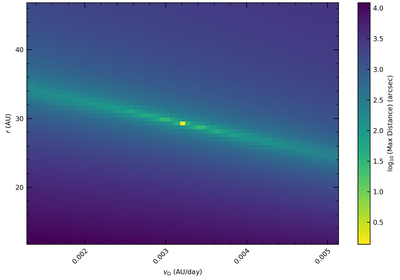
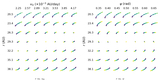
Caption: Figure 9.
Visualization of the degeneracy between barycentric distance r and tangential velocity vΩ and its effect on cluster tightness. Each cell shows the maximum angular separation between any two detections in the trajectory of an implanted object when propagated under the corresponding (r, vΩ) parameters, with vr and ψ held fixed at their true values. The true orbital parameters lie at the center of the grid, where the separation approaches zero. The diagonal band of small separations reflects a first-order cancellation between distance-induced errors in the barycentric positions assigned to the detections and velocity-induced errors during propagation to the reference epoch. Along this band, the dominant residual drift is suppressed even though the trial orbit is offset from the true orbit; the remaining higher-order geometric and dynamical residuals produce compact curled structures rather than broad dispersion. This degeneracy can cause trajectories to cluster more tightly in cells offset from the true parameters, complicating refinement during the ε-cascade.
Other Images in This Article
Show More
Copyright and Terms & Conditions
© 2026. The Author(s). Published by the American Astronomical Society.

