

Image Details
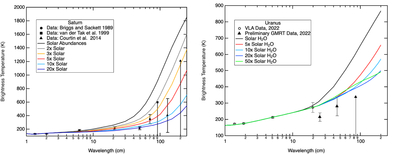
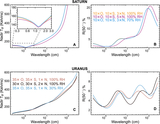
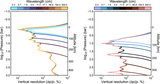
Caption: Figure A1.
Ground-based centimeter-to-meter-wavelength spectra for Saturn and Uranus, including observations from VLA, Arecibo, and GMRT. For Saturn, if all volatiles are equally enriched, the data suggest the H2O abundance is 3–10× solar. For Uranus, atmospheric water is currently unconstrained. In both plots, data points with one-sided error bars are nondetection upper limits. Models shown assume vapor equilibrium conditions and ECCM clouds (see Figure 1). For Saturn, the models all have volatile abundances enriched equally relative to solar, with NH3 and H2O being the species that most influence the spectrum. For Uranus, where volatiles appear to have drastically different abundances from one another (e.g., A. B. Akins et al. 2023), all of the models shown have NH3 and H2S abundances selected to fit wavelengths of 20 cm and shorter, and only variations in H2O are shown.
Other Images in This Article
Copyright and Terms & Conditions
© 2026. The Author(s). Published by the American Astronomical Society.

