

Image Details
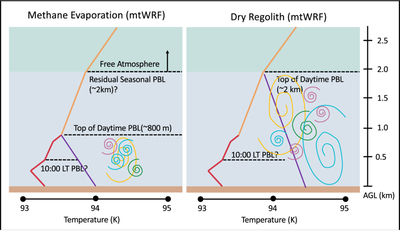
Caption: Figure 1.
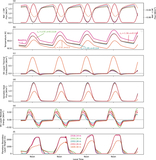
Schematic of the diurnal evolution of temperature in Titan’s PBL. The red profile represents the thermal structure at ∼10:00 am local time from the Huygens probe. A deeper adiabatic layer hypothesized to develop in the afternoon is shown in purple. Left panel (methane evaporation case): simulations including methane evaporation produce a shallow PBL of ∼500 m at 10:00 am local time, consistent with the HASI profile, which grows to a diurnal maximum of approximately 800 m in the afternoon. This structure is preserved across subsequent sols, supporting the persistence of a residual diurnal layer near 800 m and a residual seasonal signal near ∼2 km and reproducing all three layers of the HASI profile interpretation by B. Charnay & S. Lebonnois (2012). Right panel (dry regolith case): in the absence of latent heat flux, unrestricted turbulent mixing drives daytime PBL growth to depths exceeding 2 km, making it physically difficult to explain the ∼800 m residual feature identified by B. Charnay & S. Lebonnois (2012). The contrast between panels illustrates that some level of methane evaporation may be a necessary condition for reproducing the observed thermal structure at the Huygens landing site.
Other Images in This Article
Show More
Copyright and Terms & Conditions
© 2026. The Author(s). Published by the American Astronomical Society.

