

Image Details
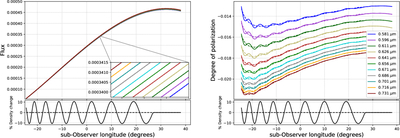
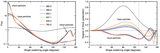
Caption: Figure 8.
The total flux (left) (normalized such that at a phase angle of 0° the disk-integrated flux equals the planet’s geometric albedo) and degree of linear polarization (right) along Venus’s equator in response to changes in the gas column number density Nm of the upper atmospheric layer for wavelengths covered by the filters (see Table 1). The composition and structure of the lower atmospheric layers (with cloud and haze particles) are the same at every longitude. The dashed lines pertain to the baseline value of Nm, i.e., 7.0 × 1027 molecules m−2 (for the atmosphere up from 70 km or down to 0.036 bars). The negative sign of the degree of polarization indicates a direction parallel to the planetary scattering plane (and the equator). The empirical model shows that wave wavelengths vary gradually from about 100 km near the terminator to around 900 km near the subsolar point.
Other Images in This Article
Copyright and Terms & Conditions
© 2026. The Author(s). Published by the American Astronomical Society.

