

Image Details
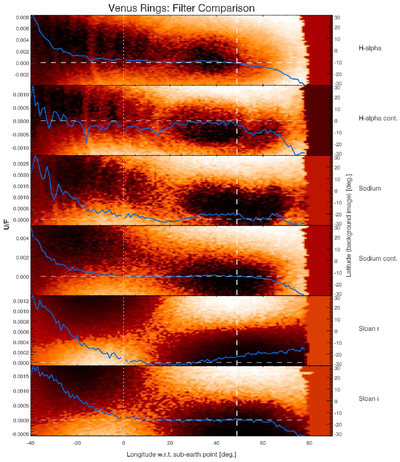
Caption: Figure 4.
The background (red-orange) shows the degree of polarization as a function of longitude with respect to the subobserver point (horizontal axis) and the latitude from −30° to +30° on Venus (vertical axis) as measured in the various filters, with the time of observation increasing from top to bottom (see Table 1). The blue line shows the degree of polarization averaged over the latitudes between −5° and +5° as a function of longitude with respect to the subobserver point (scale on the left). The degree of polarization equals U/F, with U defined with respect to the instrumental optical plane. Because the orientation of the planet with respect to this plane is almost equal to 45°, Stokes parameter U in the instrumental optical plane corresponds almost to Stokes parameter Q in the planetary scattering plane. The difference between the planetary scattering plane and the instrumental optical plane is 3°–5°. The patterns are less visible in Stokes parameter Q defined with respect to the instrumental optical plane (and hence they are much less visible in Stokes parameter U as defined with respect to the planetary scattering plane), indicating that the direction of polarization of the background signal and the rings is mostly parallel to the planetary scattering plane (see Figure 5). The vertical dotted line indicates the subobserver or sub-Earth longitude, and the vertical dashed line indicates the subsolar longitude. The horizontal long-dashed line indicates the zero polarization level for the blue lines. Note that because of the lack of accurate absolute calibration, this blue line and the zero level have an uncertainty of 1%–2%. The shape of the continuum polarization is also influenced by the difference between the planetary scattering plane and the instrumental optical plane.
Other Images in This Article
Copyright and Terms & Conditions
© 2026. The Author(s). Published by the American Astronomical Society.

