

Image Details
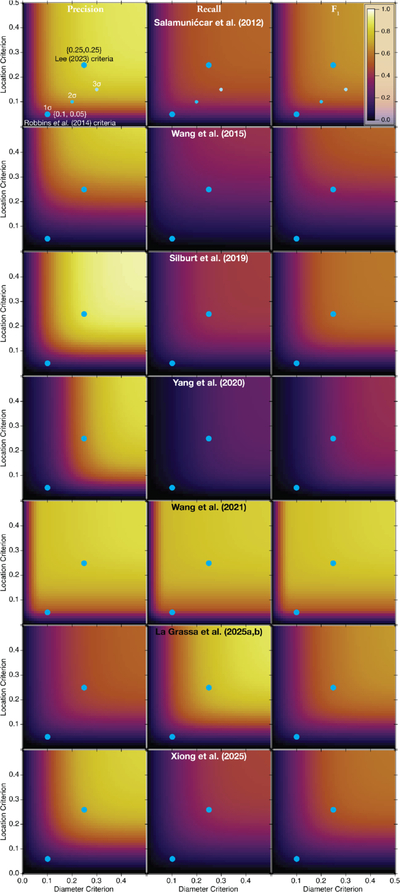
Caption: Figure 7.
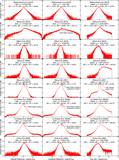
Parameter sweep using the method in Section 3, but allowing the values to vary between 0.00 and 0.50 in intervals of 0.01 each. Dmin for each is set per Tables 2 and 3. The color scale in each panel is the same range and is shown in the top right. Precision is on the left, recall is in the middle, and F1 is on the right. The R. La Grassa et al. (2025a, 2026b) data are together because they appear practically identical. Overplotted are two larger cyan shapes, which are where the C. Lee (2023) and the 1σ S. J. Robbins et al. (2014) lie; smaller, faded cyan dots in the top row are representative of 2σ and 3σ from S. J. Robbins et al. (2014). Most panels appear symmetric to first order about their diagonals, but different databases have different asymmetries, reflective of the histograms in Figure 5. This figure underscores why metrics drop significantly in Table 3 and Figure 6 when using the S. J. Robbins et al. (2014) matching criteria versus the other two: most databases have a rapid fall-off close to the (0, 0) point, and the 1σ S. J. Robbins et al. (2014) criteria usually sits within that rapid fall-off while C. Lee (2023) does not.
Other Images in This Article
Copyright and Terms & Conditions
© 2026. The Author(s). Published by the American Astronomical Society.

