

Image Details
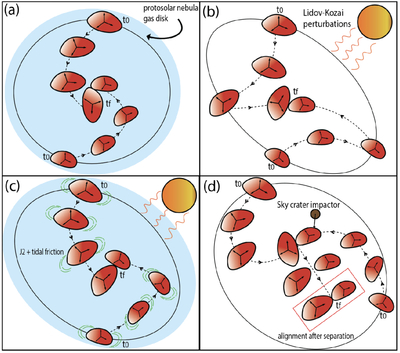
Caption: Figure 11.
Soft merger scenarios leading to Arrokoth’s final principal axes alignment. Panel (a) shows that gas drag from the protosolar nebula gradually shrinks the binary orbit between Weeyo and Wenu, ultimately causing a merger (W. B. McKinnon et al. 2020). However, this mechanism alone is insufficient to stabilize the proximity behavior of the lobes and align their principal axes upon merging. Panel (b) illustrates that non-secular LK perturbations (shown in orange) trigger large oscillations in orbital eccentricity and separation (E. Grishin et al. 2020). These perturbations can drive a collision within ∼1000 yr, but do not resolve the lobes’ unstable mutual dynamics. Panel (c) depicts a more comprehensive model that combines gas drag, J2-induced quadrupole effects, LK perturbations, and tidal dissipation also leads to Weeyo and Wenu merging (W. Lyra et al. 2021). Despite the increased complexity and frequency of interaction between these forces, they cannot align the lobes during the merger. Panel (d) describes a hypothetical scenario in which the Sky impactor reconfigured the initially misaligned merged configuration of Weeyo and Wenu (M. Hirabayashi et al. 2020; W. B. McKinnon et al. 2022; Y. Kim et al. 2024). This event caused a temporary separation of the lobes, ultimately resulting in the aligned configuration observed in Arrokoth today.
Other Images in This Article
Copyright and Terms & Conditions
© 2026. The Author(s). Published by the American Astronomical Society.

