

Image Details
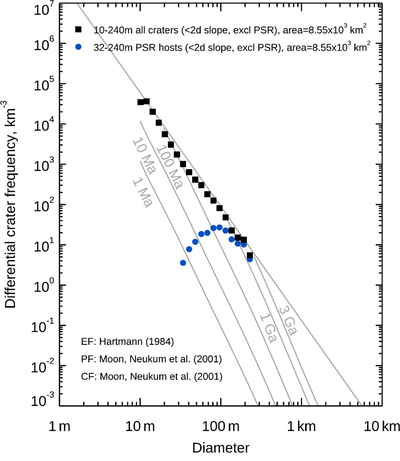
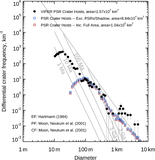
Caption: Figure 4.
A differential SFD of all detected craters and craters hosting PSRs within plains areas (specifically on areas bigger than 4 km2 of <2° slopes at 240 m baseline, south of 84°S, binned in ﹩\sqrt[4]{2}﹩ bins). Craters D ≥ 240 m are excluded as they could potentially affect the topographic slope being thresholded. The frequency of craters that host PSRs on these plains surfaces is higher than on arbitrary slopes (by an average factor of ∼2×), though in both instances, the lifetime of PSRs in small craters is geologically short (see also Figure 6). This is clearly not a crater recognition effect, as the craters are detected at orders-of-magnitude higher frequency and follow the equilibrium line as expected. However, the rollover in PSR-hosting craters at sizes smaller than 80 m is likely set by the minimum size of PSRs resolved in the LOLA PSR catalog (see Figure 5). Plotted with CraterStats (G. G. Michael 2013).
Other Images in This Article
Copyright and Terms & Conditions
© 2026. The Author(s). Published by the American Astronomical Society.

