

Image Details
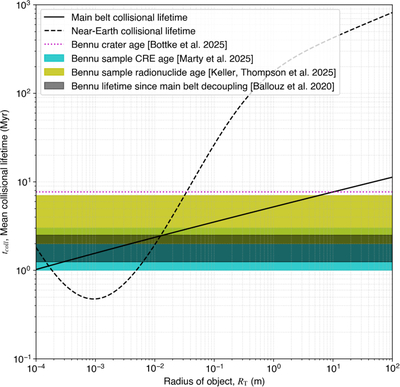
Caption: Figure 22.
The mean collisional lifetime of Bennu (and Bennu-like) particles, with radii from 0.1 mm to 100 m, on the surface of an asteroid as a function of their size, assuming impacts from main-belt (solid black curve) and near-Earth cometary and asteroidal sources (dashed black curve). Relevant ages for the surface of Bennu from crater chronology and radiometric dating of samples are also shown. The dotted pink horizontal line marks the median crater surface age of 7.7 Myr for Bennu (W. F. Bottke et al. 2025). The ranges of CRE ages (1–3 Myr) and radionuclide ages (2–7 Myr) determined for Bennu samples are shown in the cyan and yellow shaded regions (B. Marty et al. 2025; L. Keller et al. 2025). Bennu’s lifetime since it decoupled from the main belt (1.25–2.5 Myr) is shown in the gray shaded region (R. -L. Ballouz et al. 2020).
Other Images in This Article
Show More
Copyright and Terms & Conditions
© 2026. The Author(s). Published by the American Astronomical Society.

