

Image Details
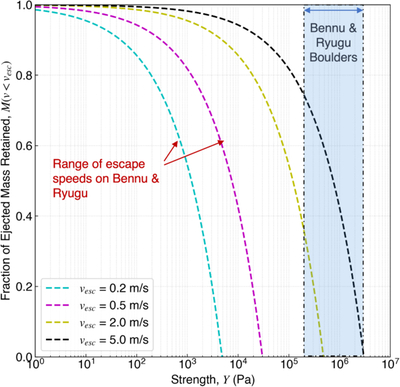
Caption: Figure 2.
Fraction of ejected mass retained, M(v < vesc), from cratering impacts into material with strength Y, and assuming material constants similar to that of weakly cemented basalt, cs = 0.122 and β = 1 (A. M. Nakamura 2017), for ρ = 1.8 g cm−3. The cyan, magenta, yellow, and black dashed curves show M(v < vesc) for vesc = 0.2, 0.5, 2.0, and 5.0 m s−1. The escape speeds for Bennu and Ryugu range from 0.2 to 0.5 m s−1. Cratering impacts into Bennu and Ryugu boulders, which have an estimated Y ∼ 0.2–2 MPa (R.-L. Ballouz et al. 2020), would lead to all of the fragments escaping the asteroid.
Other Images in This Article
Show More
Copyright and Terms & Conditions
© 2026. The Author(s). Published by the American Astronomical Society.

Copyright ©
2026 Astronomy Image Explorer. All Rights Reserved.
