

Image Details
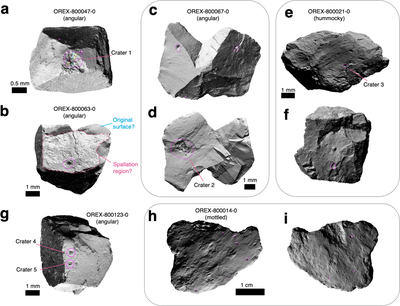
Caption: Figure 3.
Examples of craters (circled in magenta) on Bennu stones. Shown are XCT-derived shape models, visualized in the SBMT. (a) Crater 1 (∼0.6 mm diameter) on angular stone OREX-800047-0. (b) A crater (∼0.8 mm diameter) with a central pit and spallation zone on angular stone OREX-800063-0. The crater occurs on a smooth, flat region of the stone that may itself be an extended spallation region (magenta polygon) formed by the same impact. A hypothesized pre-impact surface is indicated in cyan. (c) Two craters on angular stone OREX-800067-0. (d) Crater 2, the largest crater we observed among the samples (2 mm diameter), on the other side of OREX-800067-0. (e) Crater 3, a submillimeter crater that is coincident with a linear fracture on hummocky stone OREX-800021-0. (f) A crater on the other side of OREX-800021-0. (g) Craters 4 and 5 (both ∼0.5 mm diameter) on angular stone OREX-800123-0. (h, i) Multiple millimeter-scale craters scattered on both sides of mottled stone OREX-800014-0, the largest stone returned by OSIRIS-REx.
Other Images in This Article
Show More
Copyright and Terms & Conditions
© 2026. The Author(s). Published by the American Astronomical Society.

