

Image Details
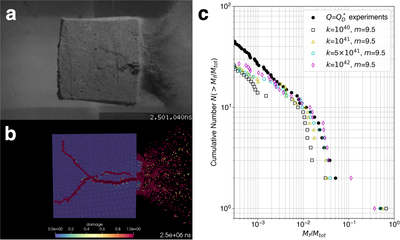
Caption: Figure 13.
Comparison of a disruptive impact experiment (CI_LG_HyFIRE_001) (a) to an SPH simulation (Sim #4) (b) at 2.5 ms after impact. The extent of damage (scalar damage parameter, d) in the simulation is indicated by color, with red indicating fully damaged. (c) We conducted impact simulations that matched laboratory experimental conditions, varying the Weibull parameter, k (e.g., W. Benz & E. Asphaug 1994), and compared the CMFD results of simulations to the experiments, finding a best correspondence for m = 9.5 and k = 5 × 1041 cm3. The number of SPH particles in each simulation is ∼730,000.
Other Images in This Article
Show More
Copyright and Terms & Conditions
© 2026. The Author(s). Published by the American Astronomical Society.

Copyright ©
2026 Astronomy Image Explorer. All Rights Reserved.
