

Image Details
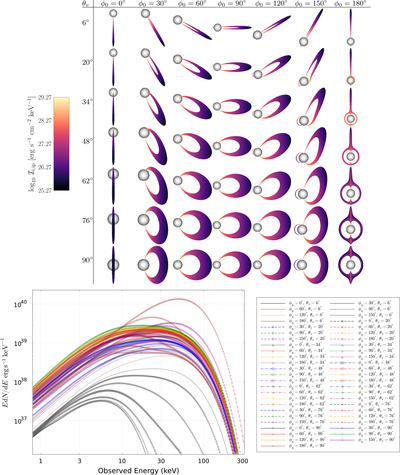
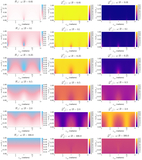
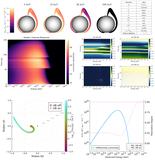
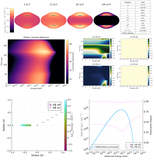
Caption: Figure 6.
Top: suite of panels at 12 keV varying θv ∈ {6°, …, 90°} and ϕ0 ∈ {0°, …, 180°} with θ0 = 18°, Δθ0 = Δϕ0 = 2°, M = 2.0 M⊙, r⋆ = 12 km, ﹩{B}_{p}^{{\rm{flat}}}=10﹩, α = 1/3, ﹩{m}_{e}{c}^{2}{{\rm{\Theta }}}_{{\rm{\max }}}=30﹩ keV, and η = 0, and splitting ⊥ → ∥∥ only. Bottom: attendant time-integrated snapshot spectra for each case. This demonstrates that geometric changes can lead to strong spectral and apparent luminosity variations. There is strong geometric and visibility enhancement of luminosity of bursts behind the NS, compared to those in the foreground that can occult high luminosity low-altitude regions of the burst. The high luminosity outlier θv = 20° and ϕ0 = 180° is a result of surface grazing trajectories near the back and lensed polar footpoints that are strongly beamed along B.
Other Images in This Article
Show More
Copyright and Terms & Conditions
© 2026. The Author(s). Published by the American Astronomical Society.

