

Image Details
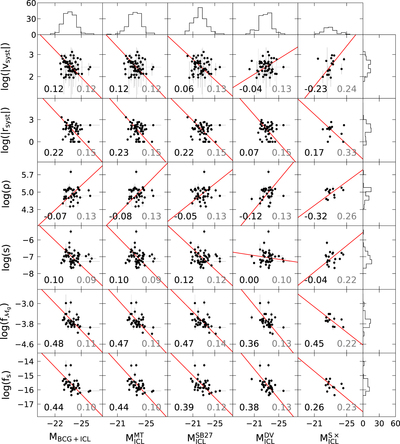
Caption: Figure 14.
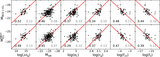
Correlations between BCG/ICL parameters (horizontal) and cluster parameters (vertical). The columns show (1) the absolute brightness of the BCGs+ICL MBCG+ICL [g′ mag], the absolute brightnesses of the ICL only MICL [g′ mag], dissected (2) via the total magnitude threshold of −21.85 g′ mag ﹩{M}_{\mathrm{ICL}}^{\mathrm{MT}}﹩, (3) via the surface brightness threshold of 27 g′ mag ﹩{M}_{\mathrm{ICL}}^{\mathrm{SB}27}﹩, (4) via the light excess above the inner de Vaucouleurs fit ﹩{M}_{\mathrm{ICL}}^{\mathrm{DV}}﹩, and (5) via the double Sérsic fit ﹩{M}_{\mathrm{ICL}}^{{\rm{S}}\times }﹩. The methods are explained in Section 5. The rows show (1) the absolute systemic velocity offset v∣syst∣ (data taken from Lauer et al. 2014), (2) radial X-ray emission peak offset r∣syst∣ (data also taken from Lauer et al. 2014), (3) mass density ρ [M⊙ kpc−3], (4) number density of satellite galaxies s [kpc−3], (5) mass phase-space density ﹩{f}_{{{ \mathcal M }}_{{\rm{g}}}}[{M}_{\odot }﹩ kpc−3 km−3 s3], and (6) number phase-space density of the satellite galaxies fs [kpc−3 km−3 s3]. The Pearson coefficient for each correlation is given as a black label and its error (calculated using 10,000 bootstraps) as a gray label. The histograms show the number of data points in each bin from the subplot containing either Msat or MBCG+ICL (see Figure 12).
Other Images in This Article

Show More
Copyright and Terms & Conditions
© 2021. The American Astronomical Society. All rights reserved.

