

Image Details
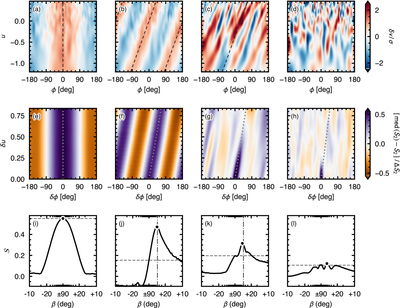
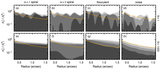
Caption: Figure C3.
What the winding contrast measures, shown on four synthetic fields of known truth at SNR = 5 (one shared GRF realization throughout). Columns, left to right: an unwound pattern or a radial spoke at β = ±90°; a coherent two-armed logarithmic spiral of pitch β = +35°; a flocculent field, an anisotropic GRF of random azimuthal phase carrying the same +35° lean but no global coherence; and the bare isotropic GRF, i.e., the null. The scan is held at m = 1 in the first column and at m = 2, the mode of the injected arm, in the other three. Top row (a)–(d): each field on the log-radial grid, ﹩u=\mathrm{ln}r﹩ against ϕ, with dashed lines marking the injected locus where there is one. Middle row (e)–(h): the surface the scan integrates, normalized by the range of the surface, [med(S2) − S2]/ΔS2, so that a correlated ridge reads as a positive (dark) trough. The dotted line is the recovered slope. Bottom row (i)–(l): the score ﹩{ \mathcal S }﹩ along that scan, on a slope-linear axis ticked in pitch. The filled circle marks the peak ﹩{ \mathcal S }({\beta }_{\star })﹩, the horizontal dashed line is the unwound reference ﹩{ \mathcal S }(\pm 90^\circ )﹩ whose difference from the peak is ﹩{\rm{\Delta }}{ \mathcal S }﹩, and the vertical dashed–dotted line is the injected pitch where one exists. Note that the spoke returns the largest ﹩{ \mathcal S }﹩ of the four and yet ﹩{\rm{\Delta }}{ \mathcal S }\simeq 0﹩, since its peak is the unwound hypothesis, and that the flocculent field recovers the correct lean at roughly one-third of the coherent arm’s depth.
Other Images in This Article
Show More
Copyright and Terms & Conditions
© 2026. The Author(s). Published by the American Astronomical Society.

