

Image Details
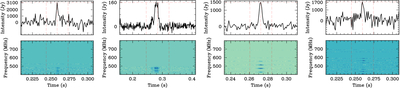
Caption: Figure 3.
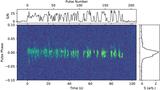
Four notable pulses from PSR J2108+5055, ordered left to right. First: pulse with the highest peak flux density, 3.1 ± 1.0 kJy, recorded in a suboptimal formed beam (Appendix B). Second: pulse with the highest fluence. Third: brightest pulse recorded close to its optimal formed-beam response, at 1.5 ± 0.7 kJy (hour angle −29﹩\mathop{.}\limits^{{\unicode{x000b0}}}﹩6). This is the fiducial pulse used in Section 3.2. Fourth: brightest pulse detected in the far side lobes of CHIME (hour angle −57﹩\mathop{.}\limits^{{\unicode{x000b0}}}﹩7). This pulse lies outside the hour angle range covered by our holography data, so its peak flux density of 1.7 kJy is a lower limit. The data shown are the total intensity recorded at 0.98 ms, with 16,384 frequency channels. The “clamping” pattern, characterized by notches in the dynamic spectrum, is a result of PSR J2108+5055 being off-axis (C. Ng et al. 2017). In the figure, we apply a static radio frequency interference (RFI) mask to remove known bad frequency channels. We also remove channels with less than 0.1 times the sensitivity of the most sensitive frequency channel. These channels usually contain no signal and thus only dilute the pulse. The pink lines show the maximum flux density and the integration region for the fluence calculation.
Other Images in This Article
Copyright and Terms & Conditions
© 2026. The Author(s). Published by the American Astronomical Society.

