

Image Details
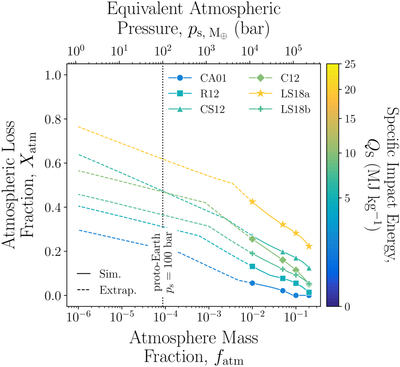
Caption: Figure 5.
Earth could have lost significant portions of its atmosphere during the Moon-forming giant impact, with significant variation depending on the impact scenario and initial atmospheric mass. Atmospheric loss fraction as a function of atmosphere mass fraction predicted by our scaling law for six Moon-formation scenarios (Table D1). Values of fatm within the range simulated in this study are shown as solid lines (Sim.) and lower value extrapolations as dashed lines (Extrap.), with line colors indicating the specific impact energy. Note that our calculation does not include rotation, which could significantly alter the loss efficiency in the M. Ćuk & S. T. Stewart (2012) case. Equivalent atmospheric pressures shown on the upper x-axis were calculated for a 1.0 M⊕ planet and thus serve only as a reference for the data points shown here. The illustrative atmospheric mass fraction for the proto-Earth, corresponding to an atmospheric pressure on an Earth-mass body of 100 bar (K. Zahnle et al. 2007; P. A. Sossi et al. 2020), discussed in the text is shown as a black dotted vertical line. The inflection points seen in many scenarios mark the point of near-field loss saturation, with additional loss coming only from the far field.
Other Images in This Article
Copyright and Terms & Conditions
© 2026. The Author(s). Published by the American Astronomical Society.

