

Image Details
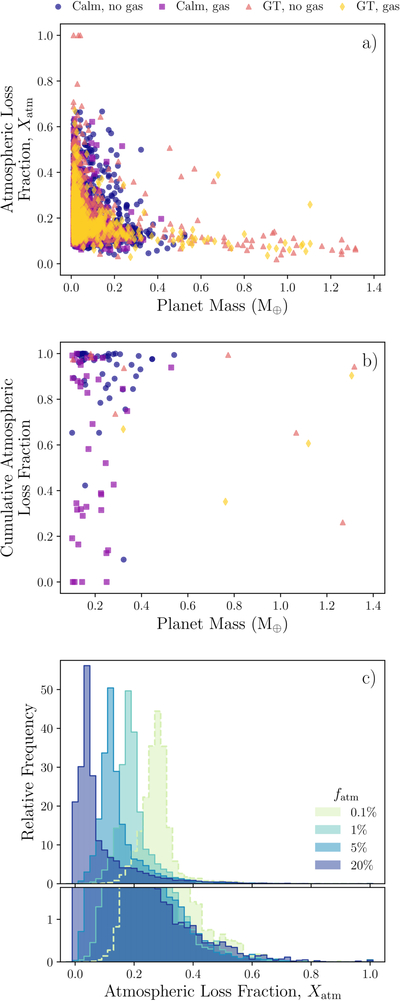
Caption: Figure 4.
The cumulative effect of many giant impacts during planet formation can lead to large variations in the volatile budgets of planetary bodies, including total loss of atmosphere. Shown are: (a) individual loss events as a function of planet mass from planets with fatm = 1% only; (b) the cumulative losses resulting from multiple impacts throughout accretion for different formation scenarios (symbols and colors); and (c) a histogram of loss efficiency from all individual impacts in the N-body accretion simulations calculated using our scaling law, assuming different pre-impact atmosphere mass fractions, fatm (colors). The relative frequency of impacts has been scaled by the number of impacts in each scenario so as not to weight any one scenario preferentially, and the total area under each histogram equals four, the number of scenarios considered. The lower panel is zoomed in on the lower frequency events. The loss for fatm = 0.1% (dashed outline) is an extrapolation of our scaling law beyond the simulation data used to fit it.
Other Images in This Article
Copyright and Terms & Conditions
© 2026. The Author(s). Published by the American Astronomical Society.

