

Image Details
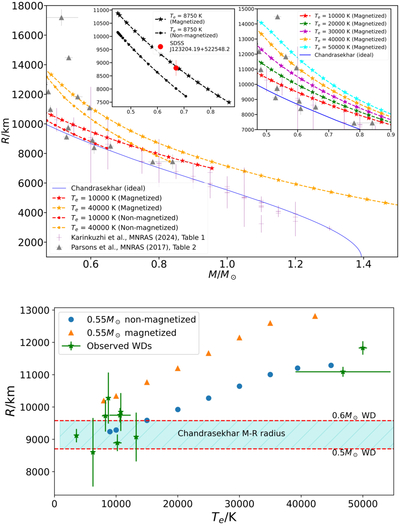
Caption: Figure 4.
Upper: effect of temperature and/or magnetic field on the M–R relation. The WDs formed by accretion onto a 0.45 M⊙ HeCO WD are further cooled to various Te and the M–R relations for a specific Te are shown. Nonmagnetized cases are shown with a dashed line with filled circle, and magnetized cases with a dashed line with asterisk. The ideal Chandrasekhar case is shown by a solid line. Low-mass outliers (S. G. Parsons et al. 2017; D. Karinkuzhi et al. 2024) mostly fall within the extent of these curves. The rightmost inset shows many more magnetized cases with various Te for completeness. The leftmost inset shows the particular case of SDSS J123204.19+522548.2 (Te = 8750 K: D. Karinkuzhi et al. 2024), confirming the magnetized WD model suffices to explain the data. Lower: the dependence of radius on Te for both magnetized (filled triangle) and nonmagnetized (filled circle) cases of M = 0.55 M⊙. Observed outliers shown therein are for 0.5 ≲ M/M⊙ ≲ 0.6, taken from the ones displayed in upper panel. The ideal zero-temperature result is shown by a zone bounded by dashed lines. In the magnetic cases, the field is specified by the profile parameters η = 1.3, γ = 0.9 (defined in Appendix A).
Other Images in This Article
Copyright and Terms & Conditions
© 2026. The Author(s). Published by the American Astronomical Society.

