

Image Details
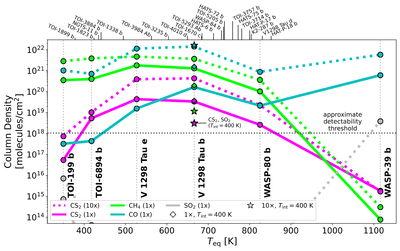
Caption: Figure 5.
Dependence of the predicted CS2, CH4, CO, and SO2 abundances, quantified as the column density (molecules per square centimeter) integrated over the JWST-observable pressure region (P ≤ 2 mbar), across a sample of gas giant exoplanets spanning Teq = 350–1120 K, assuming Tint = 100 K and Kzz = 108 cm2 s−1 for both 1× and 10× Z⊙. Colors denote different chemical species, while line styles indicate metallicity: solid lines represent 1× Z⊙ and dotted lines represent 10× Z⊙. The predicted SO2 column densities remain below 1016 molecules cm−2 for all planets considered here, except for the 10× Z⊙ model of WASP-39 b. For V1298 Tau b, additional models with Tint = 400 K were computed at both 1× and 10× Z⊙ and are denoted by diamond and star symbols, respectively. The predicted CS2 and SO2 column densities for the Tint = 400 K models are nearly identical and therefore overlap. The black horizontal dotted line indicates the estimated CS2 detectability threshold column density of 1018 molecules cm−2. This corresponds approximately to a VMR of 1 ppmv (10−6). Planets labeled along the top x-axis are gas giants (R ≥ 0.50 RJ, M ≤ 1.1 MJ) that have been or are planned to be observed with JWST using modes capable of probing CS2 absorption (i.e., NIRSpec/G395M, G395H, or PRISM). Their corresponding Teq values, ranging from 350 to 852 K, are also indicated. These targets represent potential candidates for future CS2 detections.
Other Images in This Article
Copyright and Terms & Conditions
© 2026. The Author(s). Published by the American Astronomical Society.

